
The B-Khata Trap: What Your Karnataka Khata Extract Really Tells You (And What It Doesn’t)
A lot of buyers check their Bhoomi RTC Online record, treat the Khata Extract the same way, and stop there. It isn’t a title document, though — it’s a tax record, proof that a property is entered in the municipal assessment register, not proof of who legally owns it. The actual legal proof lives in the registered Sale Deed Certified Copy Karnataka instead. Confusing the two is exactly how people end up buying properties they later discover sit in a legal grey zone.
This guide covers what a Khata Extract actually is, the real difference between A-Khata, B-Khata, and the newer e-Khata system, how to get one, what it costs, and why it should never be the only document you check before buying.
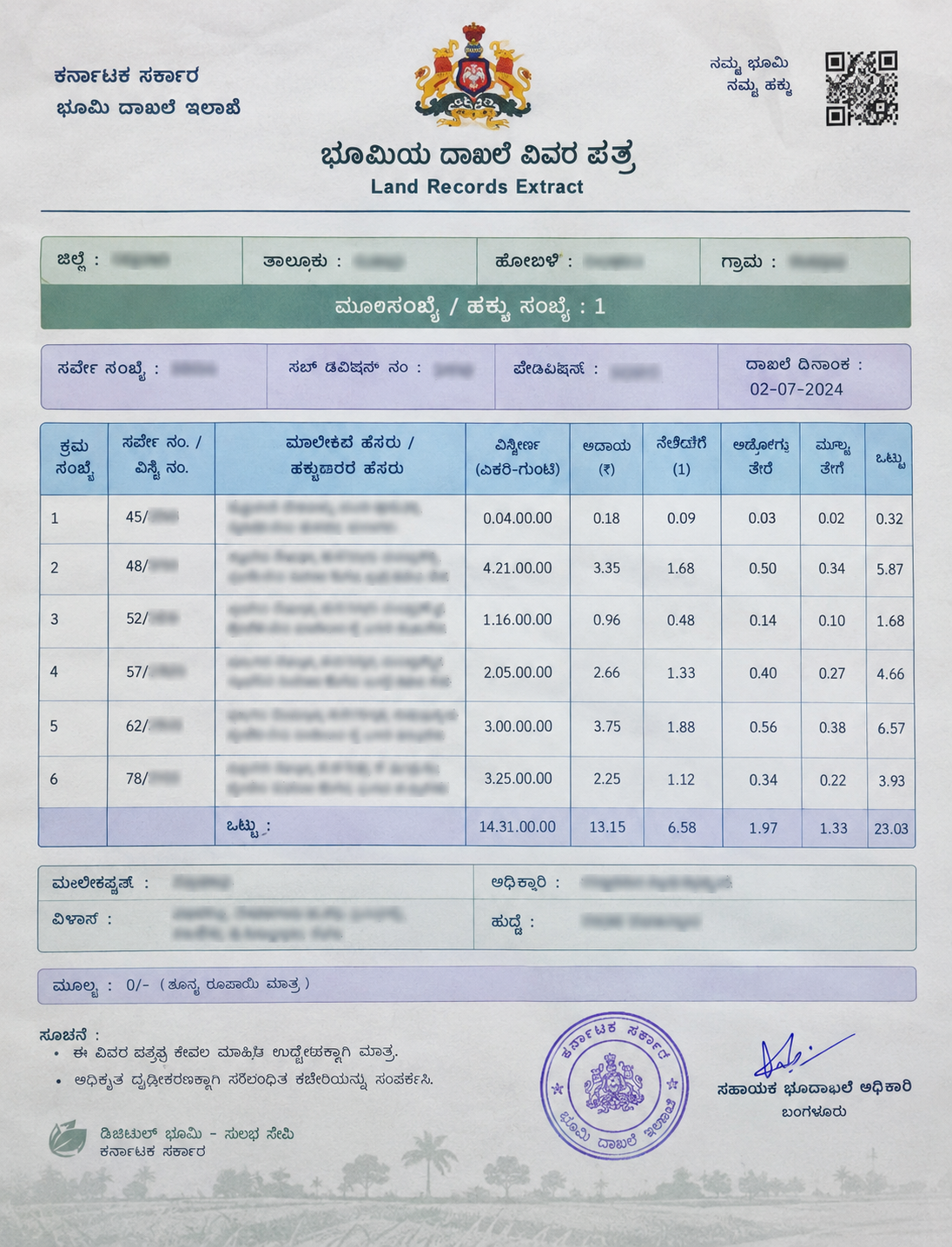
What is a Khata Extract?
A Khata is an official entry that identifies a specific property for tax purposes and records who is responsible for paying that tax. It’s issued by the local municipal body — in Bengaluru, that’s the BBMP (now transitioning under the Greater Bengaluru Authority); outside Bengaluru, it’s the relevant City/Town Municipal Council or Gram Panchayat.
Two documents come out of this system, and they’re often confused with each other:
TOGETHER
For a fully compliant property, these two are referred to as an A-Khata.
A-Khata vs B-Khata — The Distinction That Actually Matters
This is where most confusion — and most risk — comes from.
A-Khata
An A-Khata property fully complies with building bylaws, land-use rules, and tax regulations. It gets both a Khata Certificate and a Khata Extract. A-Khata status is generally what banks want to see before approving a home loan, and what makes future resale and building approvals straightforward.
B-Khata
A B-Khata property is recorded in a separate register for properties that don’t fully comply — this could mean unauthorized layouts, unconverted agricultural land used for construction, or bylaw violations. Following a Karnataka High Court order in December 2014, B-Khata properties lost whatever informal legal standing they previously had and are now treated as non-compliant. A B-Khata property only gets a Khata Extract — no Khata Certificate is issued.
This is the trap buyers fall into: a B-Khata property can still have people living in it, paying property tax, and holding what looks like official paperwork. But it typically can’t get a full construction loan, and reselling it comes with the same compliance problem passed on to the next buyer — unless it’s formally upgraded to A-Khata first, which usually means clearing outstanding taxes, completing land-use conversion if needed, and paying betterment charges.
THE TRAP
A B-Khata property can still have people living in it, paying property tax, and holding what looks like official paperwork. But it typically can’t get a full construction loan, and reselling it passes the same compliance problem to the next buyer — unless it’s formally upgraded to A-Khata first, which usually means clearing outstanding taxes, completing land-use conversion if needed, and paying betterment charges.
E-Khata The Digital Layer, Not a Third Category
E-Khata (accessed through the e-Aasthi system) is not a separate legal classification alongside A and B — it’s the digitized, QR-coded version of an existing Khata record, rolled out for Bengaluru properties starting October 2024.
A few things worth knowing about it:
What You Actually Need to Apply for e-Khata
The e-Aasthi portal isn’t a simple form-fill — it asks for real supporting documents and verification steps upfront:
MOST COMMON REJECTION REASON
Missing or mismatched documents — especially a name that’s spelled slightly differently across the Sale Deed, Aadhaar, and tax receipt — is the single biggest reason applications get stuck or rejected.
How to Get a Khata Extract
For Bengaluru Properties (BBMP / e-Aasthi)
Visit the official BBMP e-Aasthi portal
Go to the government’s e-Aasthi portal to begin your search.
Search using PID or owner details
Search using the property’s PID, or the owner’s name and address details.
View & download, if already on record
If the property already has a Khata on record, the extract can typically be viewed and downloaded directly.
File a separate application if needed
For a fresh Khata registration (common for new apartments) or a Khata transfer (required after a resale), a separate application needs to be filed — either through the Sakala citizen services portal or in person.
For Properties Outside Bengaluru
Khata records for properties under other City/Town Municipal Councils or Gram Panchayats follow a similar principle — a local register recording tax assessment against a property — but the specific online portal and process vary by local body. Check with the relevant municipal office for the current online option, if one exists for your area.
Khata applies to municipal/urban property; agricultural land outside municipal limits is tracked through RTC on Bhoomi instead, not Khata. And remember — a Khata Extract shows municipal tax records, but it doesn’t prove legal ownership; that proof comes from the registered Sale Deed.
Khata Transfer — What Happens After You Buy a Resale Property
Buying an existing property doesn’t automatically update the Khata to your name. A Khata transfer application has to be filed separately, under Section 114 of the Karnataka Municipal Corporations Act, 1976. Until that transfer is completed, the Khata still reflects the previous owner — which can create friction later when you try to sell, get a loan, or apply for utility connections in your own name.
Typical Fees Involved
Costs vary slightly by local body and have changed over time. Based on current figures for BBMP-administered properties:
BETTERMENT CHARGES VERY
Different sources report betterment charges differently — sometimes as a flat per-square-metre rate, sometimes as a percentage of land value. Given how much this varies by zone and case, treat any specific figure as a rough starting estimate only.
These figures shift periodically and can differ for panchayat or other municipal jurisdictions outside BBMP. Always confirm the current fee on the official e-Aasthi portal before paying — don’t rely on a fixed number from any guide, including this one.
Processing Timeline (Sakala Service Guarantee)
Under the Karnataka Sakala Services Act, Khata-related applications carry an official outer time limit — commonly cited as around 30 working days for a standard, clean application. In practice:
| Scenario | Typical Timeline |
|---|---|
| Clean, document-complete application | Often 7–15 working days |
| Requires physical site inspection | Typically 30–45 working days |
| B-Khata to A-Khata + transfer combined | Often 45–90 working days |
IF IT’S DELAYED
If your application sits well past the Sakala outer limit without movement, that delay itself is escalatable through the Sakala grievance/tracking system.
Who Actually Needs a Khata Extract?
Property owners
To support tax assessment & prove municipal record
Buyers
To check A/B-Khata status before committing
Builders / developers
Required for plan approvals & construction permits
Banks / lenders
Part of loan & mortgage verification
Khata Extract vs Sale Deed vs RTC vs EC — Don’t Rely on Just One
Buyers frequently assume one of these documents is “enough.” None of them individually is. Here’s what each one actually proves:
| Document | What It Proves | What It Doesn’t Prove |
|---|---|---|
| Khata Extract | The property is on the municipal tax register, and basic dimensions/assessment details | Legal ownership, or whether the underlying title is clean |
| Sale Deed (Certified Copy) | A specific registered transaction happened legally | Whether the property is currently compliant on municipal records, or free of loans |
| RTC / Pahani | Current ownership and status for agricultural/revenue land | Anything about municipal/urban Khata status — RTC and Khata apply to different land categories |
| Encumbrance Certificate (EC) | Whether the property has registered loans, liens, or claims over a chosen period | Ownership itself, or municipal compliance status |
A clean Khata Extract with no Sale Deed backing it, or a Sale Deed with an unresolved B-Khata status, are both incomplete pictures. Full due diligence checks all of them together.
Check the Sale Deed too
A Khata Extract shows tax records — the registered Sale Deed is what proves legal ownership.
Frequently Asked Questions
Disclaimer: This page is an independent informational guide. It is not affiliated with BBMP, the Greater Bengaluru Authority (GBA), or any municipal or panchayat authority in Karnataka. Always confirm fees and steps on the official government portal before making any payment.